August 9, 2026 • Marcus Delray • 10 min reading time • Prices verified June 4, 2026
New Balance 442 Fit Guide: The Wide-Foot Boot That Actually Delivers — If You Pick the Right Version
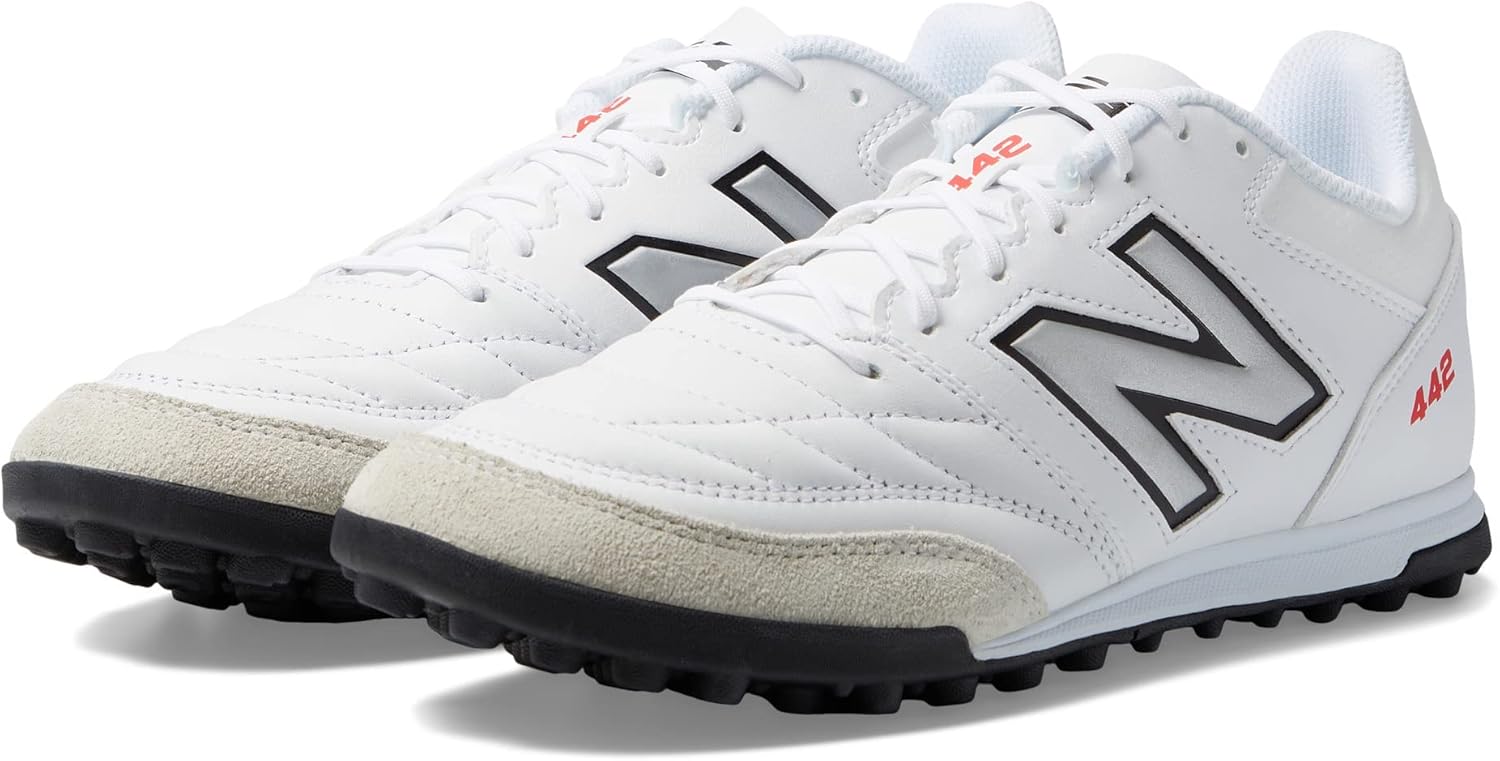
If you’ve ever had a football boot cut into the side of your foot by halftime, you already understand the problem the New Balance 442 was built to solve. Most elite football boots — the Nikes, Adidas, Pumas that dominate top-flight pitches — are designed around a narrow, performance last (the three-dimensional mold a shoe is built on). That’s fine if your foot shape matches. But a significant share of players have feet that are wider across the forefoot, higher in volume, or simply shaped differently from the anatomical assumption baked into European-market boots. The 442 is New Balance’s answer to that underserved group: a boot engineered with a wider, more accommodating last, a genuine leather upper (the material that actually stretches and molds to your foot over time), and a price point that sits between entry-level and elite. This guide will tell you exactly which version of the 442 is right for your foot shape, your surface, and your budget — and where the model’s honest limits are.
There Are Two Very Different 442s — Know Which One You’re Buying
This is the most important thing in the guide, so we’re putting it first. The New Balance 442 exists in two meaningfully distinct versions, and online listings frequently blur the line between them.
The 442 v2 Pro is the upper-tier offering: a full-grain leather (or leather-synthetic hybrid, depending on colorway) upper mounted on a stiffer TPU outsole plate with a sprint-silo-adjacent stud configuration. It’s aimed at the serious club or semi-professional player who wants genuine width accommodation without giving up the locked-down heel and plate responsiveness of a performance boot.
The 442 v2 Team is the workhorse version: a more economical synthetic upper, a softer and more forgiving outsole, a slightly more relaxed fit throughout, and a price that typically runs $40–$60 lower. It’s honest about what it is — a durable training and match boot for the player who puts in five sessions a week and needs something that won’t fall apart by February.
Per reviewers at SoccerBible in their New Balance 442 v2 Pro review, the two boots share the same last family and basic width profile, but the Pro’s upper breaks in differently — the leather conforms to the foot over 3–5 sessions in a way the synthetic Team version doesn’t replicate. If break-in fit is part of why you’re looking at this boot, the Pro is doing different work than the Team, even though they carry the same 442 name.
Decision rule, version selection:
- If you want a boot that genuinely molds to your foot’s individual contours over time → 442 v2 Pro
- If you want reliable width accommodation out of the box, maximum durability, lower replacement cost → 442 v2 Team
The Width Story: What the 442 Actually Delivers Compared to the Competition
Let’s be precise about what “wide fit” means in football boot terms, because the category is often oversold.
Width in a football boot is a function of three overlapping variables: the forefoot last width (the physical mold), the upper material’s ability to expand under load, and the toe box height (which matters for players with a high arch or prominent toe joints). The 442 addresses all three in a way that almost no other boot at this price tier does simultaneously.
Reviewers at footballboots.co.uk, in their last and fit analysis of the 442 silo, note that New Balance’s D-width last on the 442 runs approximately 4–6mm wider across the metatarsal heads (the ball of the foot) than Nike’s standard Mercurial last and roughly 3–4mm wider than Adidas’s Copa last — which is already considered among the more generous fits in the Adidas range. That gap sounds small, but for a player who has spent two seasons in a boot that’s 3mm too narrow, 4–6mm is the difference between playing through pain and not thinking about your feet at all.
By the numbers:
| Boot | Last Width Category | Upper Material | Approx. Forefoot Volume |
|---|---|---|---|
| NB 442 v2 Pro | D (wide) | Full-grain leather | High |
| Adidas Copa Pure.2 Elite | Standard-wide | Kangaroo leather | Medium-high |
| Nike Phantom GX Elite | Standard-narrow | Flyknit synthetic | Low-medium |
| NB 442 v2 Team | D (wide) | Synthetic | Medium-high |
Sources: footballboots.co.uk last analysis; Footwear News New Balance football silo overview; published manufacturer specs.
The Copa comparison is instructive because it’s the most common alternative players with wide feet consider. Owners consistently report — across aggregated reviews on footballboots.co.uk and Footy Headlines’ version comparison — that the 442 v2 Pro wins on forefoot room but that the Copa’s heel cup is more precisely engineered. If your width problem is concentrated at the forefoot and you have a standard-to-narrow heel, the 442 is the cleaner fit. If you have a wide heel as well, expect to size-match carefully regardless of which boot you choose, because almost no football boot’s heel is designed for that combination.
Surface and Stud Setup: Where the 442 Works and Where It Doesn’t
The 442 comes in FG (firm ground), AG (artificial grass), and TF (turf) configurations. This matters more than most buyers realize, and it matters more on the 442 than on many other boots because of the outsole stiffness profile.
FG (Firm Ground): The default configuration, designed for natural grass with standard firmness. The 442 v2 Pro’s FG plate is stiff enough to provide energy return through the push-off phase, but reviewers at SoccerBible note that it’s noticeably less aggressive than a true sprint-silo plate. That’s a feature, not a bug, for the wide-foot player: the 442 FG is built for control and comfort over long sessions, not purely for acceleration in a straight line. It excels on well-maintained natural grass and will hold up on firmer natural surfaces, but New Balance’s own guidance recommends against using it on artificial turf or synthetic pitches — not just for performance reasons, but because the stud configuration creates uneven pressure distribution on AG surfaces that can stress the plate over time.
AG (Artificial Grass): The 442 AG uses a multi-stud configuration with shorter, more numerous studs distributed to spread load across the surface — the correct setup for the 3G and 4G pitches that now host the majority of amateur and youth training hours in the UK, US, and across Europe. If your boot sees more mat than grass — which is increasingly the reality for club players at the recreational-to-serious tier — the AG is the version to buy. Footy Headlines’ version comparison confirms the AG-specific outsole is a genuine re-engineering, not a cosmetic change.
TF (Turf): The 442 TF drops the plate and uses a rubber outsole with dozens of small rubber lugs — correct for hard artificial turf, concrete-adjacent surfaces, and indoor sessions where a bladed stud would be dangerous. The TF loses some of the boot’s structural rigidity, which affects how the wider last feels underfoot, but owners consistently report it as comfortable for players who live on hard courts or older-generation carpet turf.
Decision rule, surface:
- Natural grass, well-maintained → FG
- 3G/4G artificial pitches (which is most club training in 2026) → AG
- Hard turf, indoor, or multi-surface → TF
- Don’t mix these up. Using FG studs on 3G is the most common warranty-voiding, ankle-straining mistake in amateur football.
Sizing Reality: How to Order the 442 Without Returning It
New Balance’s sizing on the 442 runs true to size for the length dimension — unlike some of the brand’s running-shoe lasts, which skew slightly long. The key nuance is the width grading.
The 442 is offered in standard (D-width) and, in some markets and colorways, a 2E extra-wide option. The standard D on the 442 is already wider than most competitors’ standard offerings. Players who are mildly to moderately wide — those who’ve found Predator Elite or Mercurial wearable but uncomfortable after 60 minutes — typically report that the standard 442 D resolves the problem without requiring extra-wide sizing. Players with genuinely wide feet, or those who have a bunion or prominent first metatarsal joint, may find the 2E worth seeking out.
Per Footwear News’s New Balance football silo overview, New Balance is one of the only brands at this tier actively stocking multiple width options across a football silo, which is a meaningful structural differentiator — not a marketing claim.
Practical sizing guidance drawn from owner review patterns:
- If you’re between sizes, go half-size up on the 442 — the leather upper on the Pro will fill in during break-in, and you want slight length room rather than compression.
- If you normally wear a synthetic boot a half-size up to manage width, try the 442 in your true length first — the last may already give you the room you’ve been compensating for.
- If you have a narrow heel with a wide forefoot (a genuinely common combination that most lasts penalize), lace the 442’s top two eyelets tighter and leave the lower lacing more relaxed. This is a practical workaround that owners in long-run reviews note works better on the 442 than on most boots because the boot’s heel counter is firm enough to stay in place with this technique.
The Honest Limits: Where the 442 Is Not the Right Answer
The 442 has a clear fit niche and deserves its reputation inside that niche. But it has limits worth naming.
Sprint performance. The 442 is not a speed boot. Owners consistently report that it lacks the locked-down, second-skin sensation that makes a boot like the Mercurial Superfly Elite feel like a sensory extension of your foot at pace. The 442’s wider volume and leather construction mean there’s slightly more boot between foot and ball. For a holding midfielder, a center back, or a technical player who values touch and endurance, that’s a worthwhile trade. For a winger whose entire game is built on acceleration and first-step quickness, it’s a real cost.
Weight. The 442 v2 Pro runs heavier than elite-tier synthetic boots at comparable price points — approximately 280–300g in a UK size 9, per published spec sheets, versus 180–220g for the lightest synthetic speed boots. Over 90 minutes this adds up, and players who are weight-sensitive will feel it.
Elite-tier comparison value. At its current price point (roughly $150–$200 for the Pro, $100–$140 for the Team as of mid-2026), the 442 isn’t competing directly against the $250–$350 elite tier. It doesn’t need to. But if you’re a wide-foot player wondering whether to stretch budget to the Copa Pure.2 Elite or stay with the 442, the honest answer is: the Copa’s leather quality is marginally superior, but the 442’s width accommodation is meaningfully better. Pick the problem you’re actually trying to solve.
The Decision Frame
If you are a wide-foot player — forefoot width, toe box volume, or both — who is tired of spending half of every game managing foot pain from a boot that wasn’t built for your shape, the 442 is a rare honest solution at an honest price. Pick the v2 Pro if you train on natural grass and want a boot that earns its fit over multiple sessions. Pick the v2 Team if durability and immediate comfort on a budget are the priority. Pick the surface-correct outsole configuration and don’t compromise on that.
The 442 will not make you faster. It will let you play the full 90 minutes without thinking about your feet — and for the player it’s designed for, that’s worth more than a sprint plate they were never going to fully exploit anyway.